Xinhua
20 Mar 2026, 18:18 GMT+10
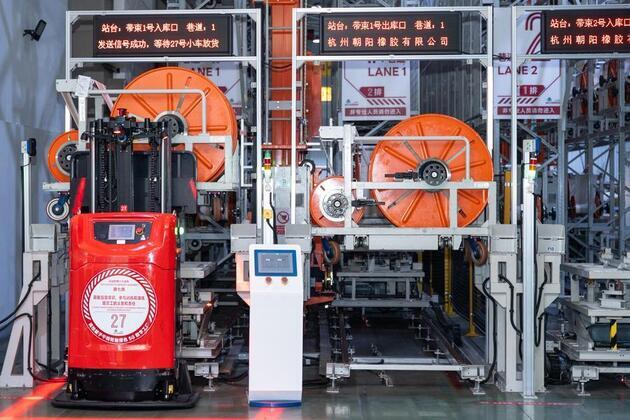
HANGZHOU, March 20 (Xinhua) -- At a rubber company in Hangzhou, a tech hub in east China's Zhejiang Province, a virtual car raced across the screen at 120 km/h, while the intelligent agent driving the vehicle ran an astounding 300 durability tests per second.
"With the intelligent agent, we can get results that satisfy automakers in just a few days," said Guo Leilei, an engineer of Zhongce Rubber Group in Zhejiang. In the past, tires were prototyped and handed over to car companies for field-testing, and this process often took at least six months, he added.
Jiang Zhiqiang, vice president of the group, told Xinhua that AI enables them to run complex processes in a "virtual factory," allowing the group to find optimal solutions prior to production.
In Zhejiang, one of China's manufacturing powerhouses, AI is evolving into a transformative force that influences how the entire manufacturing system operates -- from product design and smart manufacturing to corporate decision-making.
Unlike traditional workshops that are brightly lit and bustling with workers, the factory of Hangzhou Robam Appliances, a kitchen appliance industry leader, has earned a reputation as a "dark factory," where production lines operate with the lights rarely needed and minimal human presence.
In this factory, automated guided vehicles shuttle back and forth, while conveyor belts hum along. A smart platform featuring real-time data integration of orders, production lines and inventory allows workers to remotely issue production instructions and track the progress of orders.
The company said that since the factory was built, product development cycles have been shortened by 48 percent, production efficiency increased by 45 percent, and production costs reduced by 21 percent.
"'AI plus manufacturing' represents a profound transformation encompassing the entire manufacturing chain, including R&D, production, management and services," said Lan Jianping, deputy head of the Zhejiang Development and Planning Institute.
AI is shifting the R&D process from being experience-driven to data-driven. Wang Xueyan, an engineer with Zhongce Rubber Group, said that while product design in manufacturing traditionally relied on the expertise of engineers and trial results, AI can now rapidly sift through massive datasets to identify optimal solutions.
Such technology is optimizing resource allocation. "Production plans that used to require repeated cross-departmental coordination can now be generated automatically by the system, significantly speeding up order delivery," said Ye Guoping, general manager of Zhejiang Huilong Crystal Technology Co., Ltd.
This scenario is not unique in China's manufacturing landscape, with the country's manufacturing sector making solid progress in its digital and intelligent transformation. Across China, AI is making the leap from lab to factory floor amid the country's efforts to reshape its industrial base and move up the global value chain.
China has issued a plan to deeply integrate AI with the manufacturing sector, spanning large AI models, industrial datasets and application scenarios. According to the Ministry of Industry and Information Technology, China has built a multi-tiered smart factory ecosystem, which comprised over 35,000 basic-level, more than 8,200 advanced-level, over 500 excellence-level and 15 flagship smart factories nationwide as of 2025.
To enable its vast legacy manufacturing sector to benefit quickly from AI-powered digitalization, Chinese authorities are offering eligible facilities preferential treatment in taxation, financing, bidding and IPOs.
Shanghai in east China unveiled a three-year "AI plus manufacturing" implementation plan in 2025, aiming to achieve breakthroughs in industrial intelligence technologies. Meanwhile, north China's Hebei Province is doubling down on its "AI plus" action plan, rolling out innovative AI applications in 15 industries.
This broader orientation is reinforced in China's 15th Five-Year Plan (2026-2030). The plan places the integration of technological and industrial innovation in a prominent position, aiming to move lab-born technologies onto factory floors to unlock trillion-yuan opportunities across its real economy sectors.
The deep integration of technological innovation and industrial innovation is an inevitable trend, Ola Kllenius, chairman of the Board of Management of Mercedes-Benz Group AG, said last month in Hangzhou. "The development of electrification and intelligent transformation in China's automotive market is remarkable."
Noting that AI empowerment in the manufacturing sector is no longer an option, but a necessity, observers and industry insiders however point out that the industry still needs to overcome several hurdles.
The complexity of manufacturing scenarios demands high accuracy and stability from AI systems. "If AI makes command errors, it could create irreversible systemic risks for the production process," said You Huanjie, development department manager at Reagle Sensing, a Zhejiang-based specialized sensing technology provider focused on the industrial sector.
There remains a gap between laboratory environments and real-world industrial settings, and the alignment between AI solutions and manufacturing processes needs further improvement, said Chen Yu, GR director of Freetech Intelligent System Co., Ltd.
Local authorities also observed that high computing power costs and expensive training are also critical pain points for some companies, especially small and medium-sized enterprises, in the current implementation process of industrial AI.
Lan noted that to continuously unleash AI's potential in empowering manufacturing, talent -- particularly those skilled in both manufacturing and AI -- remains a key variable.
Get a daily dose of Manufacturing Mirror news through our daily email, its complimentary and keeps you fully up to date with world and business news as well.
Publish news of your business, community or sports group, personnel appointments, major event and more by submitting a news release to Manufacturing Mirror.
More InformationAUDLEM, England: A sharp fall in milk prices, driven by oversupply, is pushing UK dairy farmers toward losses, with many warning that...
WASHINGTON, D.C.: Smaller portions are emerging as one of the biggest trends in the restaurant industry as diners look to spend less...
HT Syndication Hyderabad (Telangana) [India], March 19: ZocialOne, the AI-powered social media marketing app built by IQUARK SOLUTIONS...
Panjim (Goa) [India], March 19 (ANI): Aam Aadmi Party on Thursday announced local businessman Gitesh Naik as its candidate for the...
Kolkata (West Bengal) [India], March 19 (ANI): Aam Janata Unnayan Party (AJUP) founder and former All India Trinamool Congress (TMC)...
As tensions between the U.S.-Israeli force and Iran escalated in March, raising fears over the security of one of the world's most...
GUILDFORD, U.K./RICHMOND, Virginia: A surge in gasoline prices linked to the Iran war is beginning to ripple through the auto market,...
LONDON, U.K.: Chinese electric vehicle maker BYD said on March 13 that it will launch a new premium EV in Europe next month capable...
HANGZHOU, March 20 (Xinhua) -- At a rubber company in Hangzhou, a tech hub in east China's Zhejiang Province, a virtual car raced across...
(260320) -- DAEJEON, March 20, 2026 (Xinhua) -- Rescuers work at the site of a fire that broke out at an automotive parts manufacturing...
Shanghai became a city-wide showcase during the 2026 F1 Chinese Grand Prix, blending racing fervor with tangible economic impact and...
(Photo credit: Tim Fuller-Imagn Images) Alex DeBrincat scored the go-ahead goal and assisted on Detroit's two other goals as the...